
Why Protection Matters
How does groundwater contamination happen?
Pollution can have a detrimental impact on the water supply, and in some cases can permanently ruin a source of water. The video below explains how groundwater contamination happens, followed by four graphics with additional details.
Learn More
Groundwater Pollution Graphic
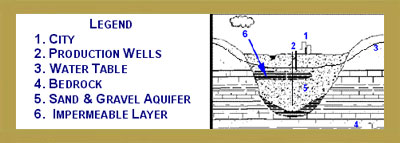
How is groundwater contaminated? The following graphics details four steps that result in contamination:
Step 1: Pollutant is Released
A hazardous substance is released at or near ground surface.
A spill occurs at ground surface and a hazardous substance enters the unsaturated area just below the surface. This unsaturated area is known as the vadose zone. Once released, the contaminant mixes with soils and sediments. Precipitation percolating down through the soils and sediments will carry the contaminant towards the water table, which marks the beginning of saturated sediments. Many organic compounds can linger in the soil for years before either evaporating into the atmosphere, or breaking down through microbial action.
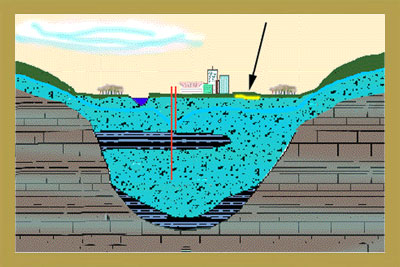
Step 2: Spill Percolates through Soil
The contaminant seeps downward and begins to disperse in the aquifer. The contaminant now has formed a contaminant plume.
In Step 2, the effect of a complex pollutant, such as gasoline, can be seen. A complex pollutant is one containing more than one compound. When these pollutants reach the water table, the different compounds often separate and either sink or float within the aquifer.
All contaminants are affected to some extent by the flow of groundwater, which slowly causes the contaminant to spread out into a plume. The plume is the path in which the contaminants are moving through the aquifer. The size of the plume will vary with the physical and chemical nature of the contaminant(s) and the aquifer (see Step 3).
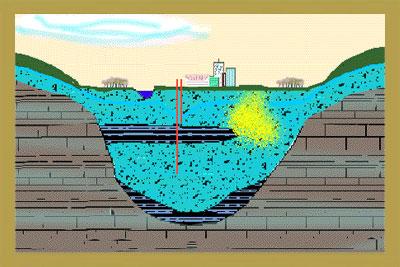
Step 3: Spill Moves Through Aquifer Toward Wells
The contaminant continues to spread. As the plume expands, parts of the plume are drawn towards the wells by the suction force created from pumping the well
The rate at which a contaminant will move through the aquifer will vary not only with the characteristics of the aquifer but also with the characteristics of the contaminant. Some contaminants are heavier than water and will continue to sink until reaching an impervious surface. These types of substances are often called “sinkers” or DNAPL’s (dense non-aqueous phase liquids). Many chlorinated solvents such as perchloroethylene (“per-kloro-ethyl-een”), a cleaning solvent, are sinkers. Other contaminants are lighter than water and “float” near the water table. These types of substances are called “floaters” or LNAPL’s (light non-aqueous phase liquids). Petroleum is an example of a floater.
It is important to remember that although most pollutants tend to float or sink, all can dissolve in water to a certain level, further increasing the severity of contamination and difficulties involved in remediating the contamination.
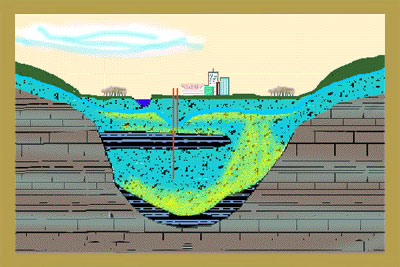
Step 4: Chemicals Drawn into Public Water Supply
Contaminant is drawn into the wells and enters public water supply
Once contaminated, groundwater may remain so for a very long time and cleanup can be very difficult and expensive. In some cases, it may not be possible to remove the contaminant completely. The costs to a community can be significant.
A water supplier must now decide how to respond to the contamination. The first step is shutting down the contaminated well until the impact of the contamination can be fully assessed. The water supplier may have to purchase additional water from another supplier if the remaining non-contaminated wells cannot produce enough water to meet community demands. The water supplier must then determine:
- What the source of the contaminant is;
- If the contaminant can be removed through the normal water treatment process
- If the contaminant can be removed in the well field, possibly by pumping the contaminated groundwater to prevent continued spreading of the plume; or
- If the well or well field must be totally abandoned and a new source of water found for the community.
Cost of Contamination
Clean groundwater is a must to be used as a reliable source of drinking water. Once groundwater is contaminated there are many costs associated with cleanup including:
Direct Costs of Groundwater Contamination
- Investigation costs (soil and water testing)
- Legal fees to recover investigation and treatment costs (if responsible party is identified)
- Clean up and remediation costs
- Costs of public information/education addressing contaminated drinking water supply
- Costs of buying a temporary water supply from another community (often at higher rates)
- Professional consulting fees to locate a new well or well field
- Costs of new well or well field development (wells and transmission lines)
Indirect Costs of Groundwater Contamination
Increased monitoring expenses
- Loss in property values
- Lost jobs (if industry must relocate due to water costs)
- Decline in consumer confidence in water supply
- Potential lawsuits from consumption of contaminated water in case of treatment failure.
Costs from Ohio EPA’s “The Costs and Benefits of Wellhead Protection and Financing Options”