Spill Planning & Emergency Response
Contingency Planning & Spill Response
What happens if groundwater does get contaminated? This could happen through illegal dumping or chemical/petroleum release, but either way, a contingency plan must be in place. The following section outlines conditions necessary for action to be taken and what the Consortium’s general Contingency Plan is for the area. Obviously, not all spills or releases are alike so each incident is addressed differently.
Groundwater contamination can strike any community at any time. Faulty or corroded hazardous material storage units, fires, shipping and handling accidents, human error, product mismanagement and in some cases, intentional illegal dumping of hazardous materials all can result in groundwater contamination despite the variety of regulatory and non-regulatory preventative measures instituted under the Source Water Protection Program (SWPP).
Learn More
SWPP Contingency Planning in the Hamilton to New Baltimore Area
The Hamilton to New Baltimore Groundwater Consortium’s SWPP Contingency Plan addresses contingency planning for both incident-related releases (IRRs), i.e., those hazardous materials releases associated with an accident, and releases detected through a monitoring well. The primary objective of the plan is to ensure that the Consortium is informed of and kept up to date on the status of hazardous material releases in the Source Water Protection Areas. By including the Consortium in the notification/information loops, the Consortium can evaluate the specific nature of a release; remediation activities; and the potential for long-term groundwater quality impacts. Secondary objectives include tracking the occurrence of regulated substance releases in the SWPAs, spill prevention awareness, and general groundwater education for area fire departments.
The Consortium’s Contingency Plan is based around three main components: notification to the Groundwater Consortium Manager (GCM), submission of release information, and incident assessment.
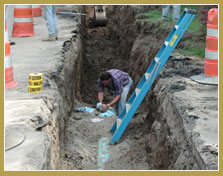
Investigating a 600-gallon oil spill
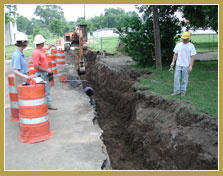
Soil sampling to look for contaminants
Notification of the Groundwater Consortium Manager (GCM)
Not all releases in a SWPA require notification to the Groundwater Consortium Manager. Only those releases which:
- Contact a pervious ground surface; or
- Enter a surface water body; or
- Enter a dry well or storm sewer; and which
- Is not immediately and completely remediated within (24) hours
are required to be reported to the GCM. Notifying the GCM does not alleviate the responsible party’s obligation to contact other federal, state, and local emergency response agencies.
Submission of Release Information
When a facility operator contacts the GCM to report a release, the facility operator must provide general information on facility location, the nature of the release, material(s) released, and estimated volume of the release. This information will be logged onto a Regulated Substance Release Notice (RSRN) form. Within seventy-two (72) hours of the release, the facility operator also will submit a Preliminary Release Report (PRR) containing additional and/or revised information on the release and response actions taken.
Incident Assessment- The Incident Management Assessment Team
Any release in a SWPA is subject to review and assessment by an Incident Management Assessment Team (IMAT) to determine if any or additional follow-up action needs to be taken by the Consortium. Representatives from the Consortium serve as the primary IMAT members. Other members, where applicable, include Consortium lab directors; responding fire department personnel; local/state emergency management agency representatives; and/or any other technical expert(s) needed for a complete assessment of the release.
A determination of what additional follow-up work may be needed is based on consideration of a variety of factors, including location of release, site of detection and nature of the material.
Emergency Response
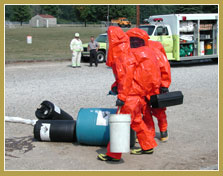
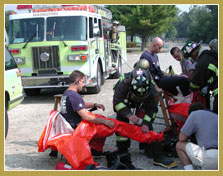
In the case of an emergency, the Consortium works with several other agencies to form an IMAT (Incident Management Assessment Team). This team consists of Consortium members and Lab Directors, representatives from the responding fire departments, Ohio EPA and any other technical expert needed for a complete assessment of the release in question. There are two types of releases an IMAT team could respond to:
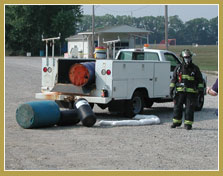
Alternate Water Supply
All the Consortium members have contingency plans for having an alternate water supply in the event of pollution or water interruption. This could be an alternate location to drill a well, for example, to access water. The Consortium is constantly evaluating, sampling and measuring the water table and the capacity of the aquifer to meet demands of the public.
The Consortium has a network of early warning wells that are sampled several times a year for pollution. If pollution is detected in a monitoring well, we will determine if action needs to be taken to determine the extent of contamination, where it is coming from and if it is necessary to clean up the pollution. These actions are considered only if we determine its a threat to the drinking water supply.
Together, the Consortium Members work to:
- Actively assist with the evaluation of expansion options of the aquifer to meet current water availability for one another.
- Annually evaluate contingency plans for all of the Consortium members and the areas that they represent. They revise them to meet current needs in the event of an emergency or contamination.
- When they do decide on a site for a drinking water well, a pollution source inventory is conducted in the area to determine past, present and future potential pollution sources.
The objective of the Alternate Water Supply planning is to make sure water customers maintain high quality uninterupted water service 24 hours a day 7 days a week. The members of the Consortium play a major role in helping to safe guard the existing water source and plan together to develop other sources of water in the region.